
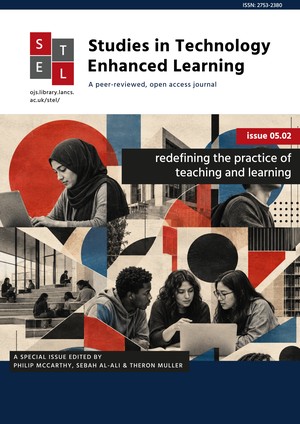
CfP: Special issue: Redefining the practice of teaching and learning
Guest editors
Philip McCarthy, Department of English, American University of Sharjah, UAE
Sebah Al-Ali, Department of English, American University of Sharjah, UAE
Theron Muller, Faculty of Human Sciences, Waseda University, Japan
Background
The integration of digital technologies into higher education has long been marked by cycles of enthusiasm, concern, and uncertainty. This pattern emerged with computers (Brady, 1990), search engines (O’Hanlon, 1999; Walster, 1997), social media (Alexander, 2006), and now generative AI. While these tools initially appear disruptive and raise conflicts between established traditions and necessary innovation, they urge us to critically examine long-standing beliefs and assumptions about how educators teach, how students learn, how researchers work, and how disciplinary fields evolve. The tools also question our understanding of expertise, craft, creativity, and scholarly judgment. Despite many efforts over the years to resolve these tensions and questions, emerging technologies such as GenAI repeatedly spark the same debates and emphasize the need for ongoing critical reevaluation of teaching, learning, assessment, research, and disciplines in higher education.
This Special Issue focuses on how digital technologies actively reshape, constrain, or transform teaching and learning practices, professional identities, institutional systems and governance structures, and the boundaries of scholarly disciplines themselves in higher education settings. We particularly welcome:
- Submissions from faculty, graduate students, doctoral researchers, and professional staff across disciplines and contexts.
- Work from newer researchers and colleagues returning to scholarship.
- Diverse methodological approaches, including conceptual, qualitative, quantitative, and mixed-methods studies.
- Original contributions that develop or apply theory, or provide critical analysis of technology-mediated practices.
- Work examining AI governance, algorithmic decision-making, guardrails, risk management, and ethical infrastructure in higher-education contexts.
Scope of papers
We seek contributions that explore how technologies in higher education contexts enable, constrain, or transform teaching, learning, research, disciplinary practice, and institutional decision-making systems (e.g., assessment platforms, admissions screening, learning analytics, AI governance tools). Papers may address specific tools, examine particular practices, focus on specific contexts, explore critical values, or consider different stakeholders.
Topics and areas of submissions might cover:
- Changes to teaching, learning, and assessment in higher education contexts.
- Discipline-specific practices across diverse fields, including STEM, creative writing, language education, social sciences, and humanities.
- Disciplinary norms and boundaries, including questions of expertise, craft, and what counts as legitimate scholarly work.
- Critical perspectives, including sustainability, equity, privacy, and institutional power.
- Research practice, supervision, and doctoral education.
- The work of non-teaching roles in higher education including instructional designers, learning technologists, librarians, and academic support roles.
- Institutional contexts, policies, and infrastructures across diverse settings.
- Administrative and leadership practices, including decision-making, resource allocation, and technology implementation.
- AI governance, algorithmic bias, guardrails, accountability frameworks, and institutional risk management in higher education.
We welcome submissions from diverse settings, disciplines, and backgrounds, covering qualitative, quantitative, and mixed-methods studies, as well as conceptual analyses, design-based research, and reflective practitioner work.
Paper types
We expect submissions to vary in length and format. When submitting your proposal, please specify the type of paper you are contributing by selecting from the categories below.
- Synthesis paper (6,000-12,000 words)
Integrative reviews or theoretically informed analyses that synthesize existing scholarship or offer new conceptual frameworks. - Standard paper (4,000-8,000 words)
Empirical, conceptual, or analytical work presenting original research or critical insight. - Commentary (2,000-4,000 words)
Concise reflective or argumentative pieces addressing focused issues relevant to the Special Issue. - Book review (1,000-3,000 words)
Reviews of scholarly works that contribute to debates about technology and higher-education practice.
Creative practitioners may submit Standard papers or Commentaries that examine technology's role in creative work.
All articles will be double-blind peer-reviewed, apart from clearly labelled editorials and invited commentaries. Articles will be distributed under the Creative Commons Attribution 4.0 International Licence (CC BY 4.0).
Submission instructions and provisional timeline
Please submit full papers through the Studies in Technology Enhanced Learning website:
Abstracts are due in mid December 2026 and submissions of full papers are due in mid April 2027. Once submitted, papers will be sent out to peer review.
Once major or minor revisions are completed, authors will receive typeset versions for checking.
References
Brady, L. (1990). Overcoming resistance: Computers in the writing classroom. Computers and Composition, 7(2), 21-33.
O’Hanlon, N. (1999). Web Search Engines Evolve to Meet Challenges. Reference & User Services Quarterly, 38(3), 247–251. http://www.jstor.org/stable/20863557
Walster, D. (1997). Search engines on the World Wide Web. Emergency Librarian, 24(3), 21-3.
Alexander, B. (2006). Web 2.0: A new wave of innovation for teaching and learning?. Educause review, 41(2), 32.