
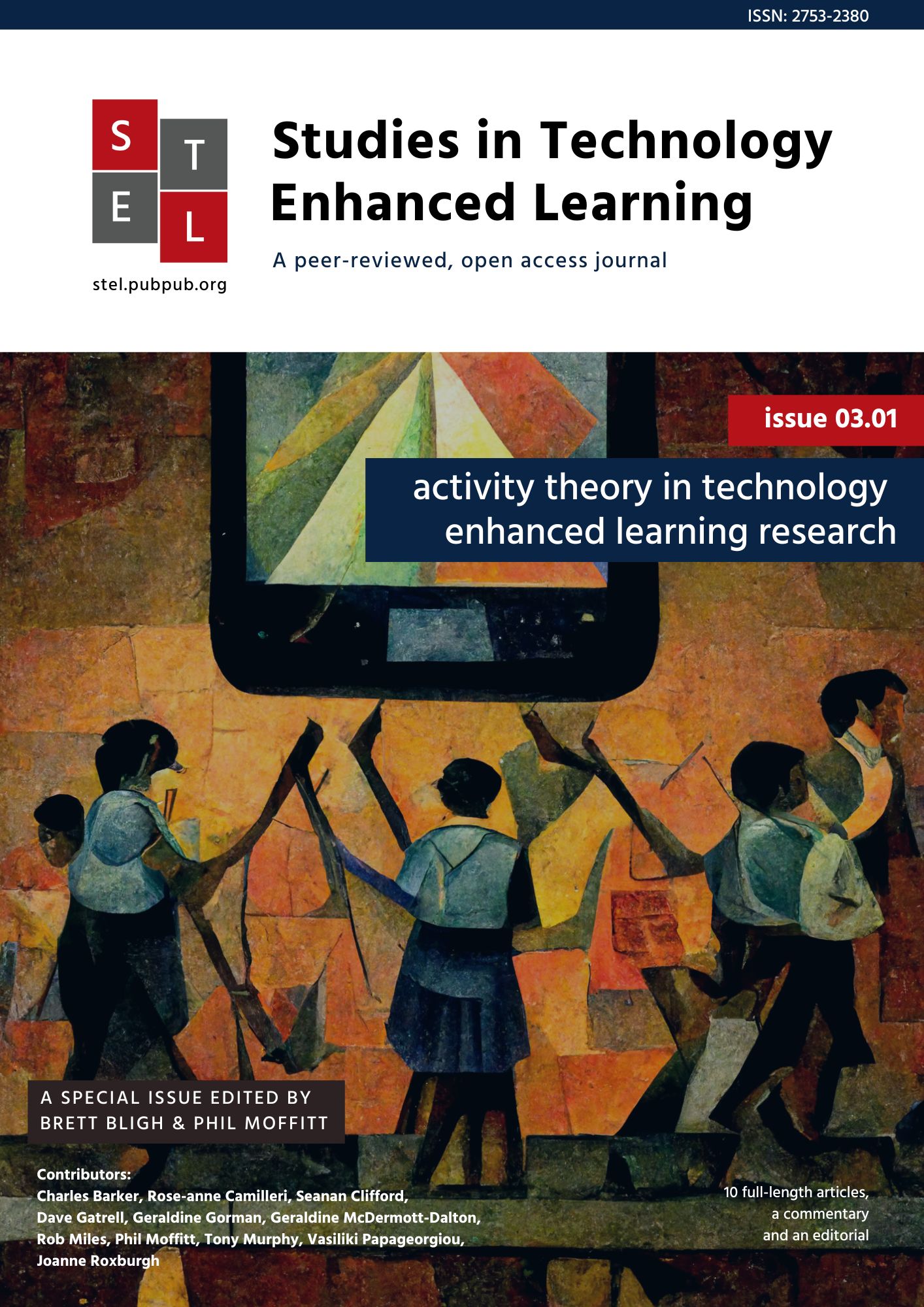
The special issue is edited by
Brett Bligh, Department of Educational Research, Lancaster University, Lancaster, United Kingdom, and
Philip Moffitt, Professional Engineering Wing, The Royal School of Military Engineering, Brompton Barracks, Chatham, United Kingdom.
Activity theory (sometimes known as Cultural Historical Activity Theory, or CHAT) is an established theory widely used in technology enhanced learning research, as well as many other fields of enquiry. A mature theory yet still under active development, it foregrounds the role of ‘technologies’ as being central to everything that humans do. Activity theory is often valued for its ability to grasp the dynamics of complex social situations and place phenomena in context, yet its dense terminology and long history of debate can seem unforgiving for newcomers. This special issue considers the use of activity theory within technology enhanced learning research, collecting together a range of papers describing research endeavours that use activity theory to understand how social and cultural contexts are crucial for how technology is used in practice.